Your Questions, Answered
MEASURE D IS A LAND-USE VOTE
What does Measure D do?
Measure D is the right to vote.
As law, it requires voter approval before permanent and consequential changes are made to the ten city-owned downtown parking plazas. Measure D guarantees a community vote on the sale or repurposing of these specific public lands; Los Altos has already has similar voter-approval laws for parks, open space, and the civic center.
The ten Los Altos city-owned downtown parking plazas are each approximately one acre. It total, they are estimated to be worth $110 million, a significant public asset currently without voter protection.
MEASURE D IS HOUSING COMPLIANT
Read on to learn more about housing compliance, but know that the City has confirmed (9/8/26) that Measure D will not trigger Builder’s Remedy nor No Net Loss, and residential neighborhoods will not need to be rezoned. The City will amend they Housing Element to reflect Measure D as a constraint, but the Downtown Parking Plazas are not required sites to stay housing compliant*.
Are there exemptions?
Yes. Affordable housing on Plazas 7 & 8 is exempt from voter-approval, not interfering with the certified Housing Element.
Maintenance and improvements to current parking infrastructure also do not require a vote.
What does “affordable housing” mean?
Measure D’s use of the term is consistent with the certified Housing Element. State standards are housing costs of no more than 30% of household income tied to Santa Clara County Area Median Income (AMI); there are 4 core tiers of income in housing planning.
What is a Housing Element?
A required element/chapter of the City's General Plan that provides a strategy for producing housing. Every 8 years, California cities must update their housing element for State approval; current cycle is 2023-2031.
What is Los Altos’ certified Housing Element housing commitment?
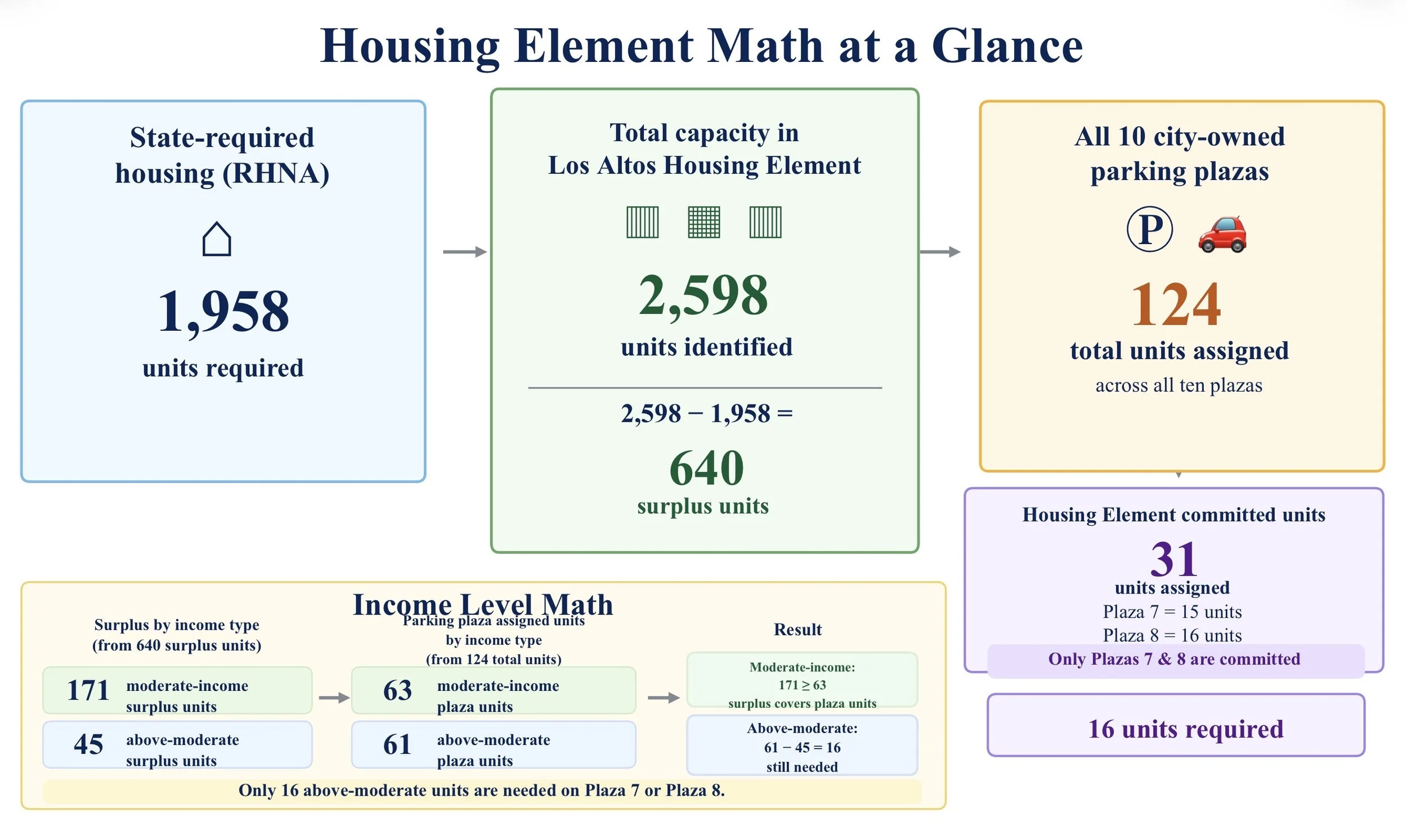
1,958 housing units are required city-wide in the state-mandated 2023-2031 RHNA (Regional Housing Needs Allocation). Current Housing Element identifies a capacity of 2,598 units. Los Altos has a surplus of 640 units or “opportunity sites.”
How many housing units does the Housing Element designate for the city-owned parking plazas?
124 total units: 63 moderate-income and 61 above-moderate-income.
How many “committed sites” does the Housing Element designate for the city-owned parking plazas?
Housing Element Program 1.H commits to affordable housing on “at least one” plaza of Plazas 7 & 8. The City had issued a Request For Proposal (RFP) from developers but has not accepted one.
What is the HCD?
HCD is the California Department of Housing & Community Development. HCD monitors Housing Elements for substantial compliance with state law and provides guidelines/processes for remaining compliant.
Does Measure D trigger Builder’s Remedy?
No. Los Altos has a state-certified Housing Element. HCD confirmed that passage of Measure D does not automatically put the City out of compliance, that a Housing Element amendment can address Measure D as a new constraint, and that Builder’s Remedy is not triggered and not available during the amendment process.
Does “No Net Loss” apply?
No. Measure D does not lower the residential density assumed for any Housing Element site.
Would other areas or residential neighborhoods need to be rezoned if Measure D passes?
No. Measure D does not trigger No Net Loss and does not require zoning changes.
City Council’s development of non-housing projects on parking plazas, however, might affect opportunity-site planning in later housing cycles.
MEASURE D DID THE MATH
There is a surplus capacity?
Yes. The Housing Element identifies 640 more units than the state-mandated 1,958. Of the surplus, 171 are moderate and 45, above-moderate income units. Parking Plazas include 63 moderate and 61 above-moderate income units total.
*What housing must be built on the parking plazas?
The City needs 16 above-moderate-income units after applying existing surplus capacity. 16 units on either Plaza 7 or 8 satisfy commitments and no vote is required. Other paths to these 16 units are also possible.
REPORTS AND LETTERS
What is the 9212 Report?
9212 is an optional impact analysis of Measure D commissioned by the City in June 2026. Report author M-Group focused mainly on potential revenue impacts; the plazas currently do not generate direct City revenue. Page 51 confirms a 16-unit above-moderate income units requirement.
What are the YIMBY Law letters?
Two letters were attached to the 9212 report without explanation. One discusses SB330, a law developers invoke to speed up housing. The other speaks to possible legal action YIMBY Law could take against the City regardless of whether Measure D passes.
Who is YIMBY Law?
They are a pro-housing nonprofit, but not a law firm. YIMBY Law has won or settled fewer than half of 24 California lawsuits they’ve filed or been party to, most involving cities without a certified Housing Element.
What about Housing?
Automatic decertification? No.
Builder’s Remedy? No.
Los Altos did a good job of identifying 640 surplus housing units of various income levels in the 8-year certified Housing Element. By the math, the Downtown Parking Plazas are not required for housing beyond the 16 units of above-moderate income on either Plaza 7 or 8.
The opposition to Measure D argues that housing compliance is the issue; it is not. City Council is moving forward with non-housing project plans (park, performing arts, parking garage) on Plazas 1, 2 and 3 because they also know that housing compliance is not at risk as long as Plaza 7 or 8 is developed with 16 units. Measure D exempts Plazas 7 and 8 from voter-approval allowing the City to meet its housing requirements.
When Measure D passes the City is not “automatically out of compliance;” the HCD has confirmed. The City will need to amend the Housing Element to include voter-approval as a constraint much like utilities, fees, etc. Builder’s Remedy is not available during the amendment period.
Measure D is most critical for voter-approval on non-housing projects and/or the sale of city-owned land
What is important is to understand is whether city-proposed non-housing projects on the parking plazas jeopardize future housing requirements from the state. Only due to their own actions, City Council may need to rezone or up zone if the downtown parking plazas are no longer available options. Measure D gives residents the vote.